
Danganronpa V3 Review: A Killing-Game Mystery Built for Class Trials, Not Casual Kids



Danganronpa V3: Killing Harmony is Spike Chunsoft’s mobile release of a full visual-novel mystery: students with “Ultimate” talents are trapped in a deadly school life, investigate murders, and settle each case in high-speed Class Trials. As of 2026-10-23, the Google Play listing checked for this review shows no ads and no in-app purchases listed for package jp.co.spike_chunsoft.DRV3. That commercial quiet does not make the content gentle. The game is steeped in murder, deception, psychological pressure, and dark humor, and it is not appropriate for children.
This review focuses on how the mobile version structures investigation and trials, what beginners should expect from the campaign, and who should leave the title alone.
Content Warning Before Anything Else
Expect frequent themes of killing, betrayal, coercion, and emotionally heavy revelations. Presentation includes stylized violence, theatrical despair, and dialogue that can be intense even when the camera is not graphic. If you want a light school story, a cozy mystery, or a title safe for younger players, stop here and choose something else. Parents should treat the package as mature entertainment, not as a cartoon adventure because of its colorful cast design.
The Core Loop: Explore, Investigate, Debate, Live With the Verdict
Between cases you move through the academy, speak with classmates, and gather free-time bonds. When a murder occurs, the game shifts into investigation: examine scenes, collect evidence, and build a mental inventory of what can later contradict a lie. The Class Trial is the signature payoff. You use gathered proof in fast minigame debates, shoot down weak statements, and—unique to this entry—sometimes deliberately lie to push a line of argument when pure truth is not enough to break a deadlock.
The loop is chapter-based rather than infinite. Each case has a beginning, a pressure spike, a trial, and a consequence that rewrites the remaining cast. Saving often is part of responsible play; long reading sessions and multi-stage trials punish an accidental close more than a short arcade game would.
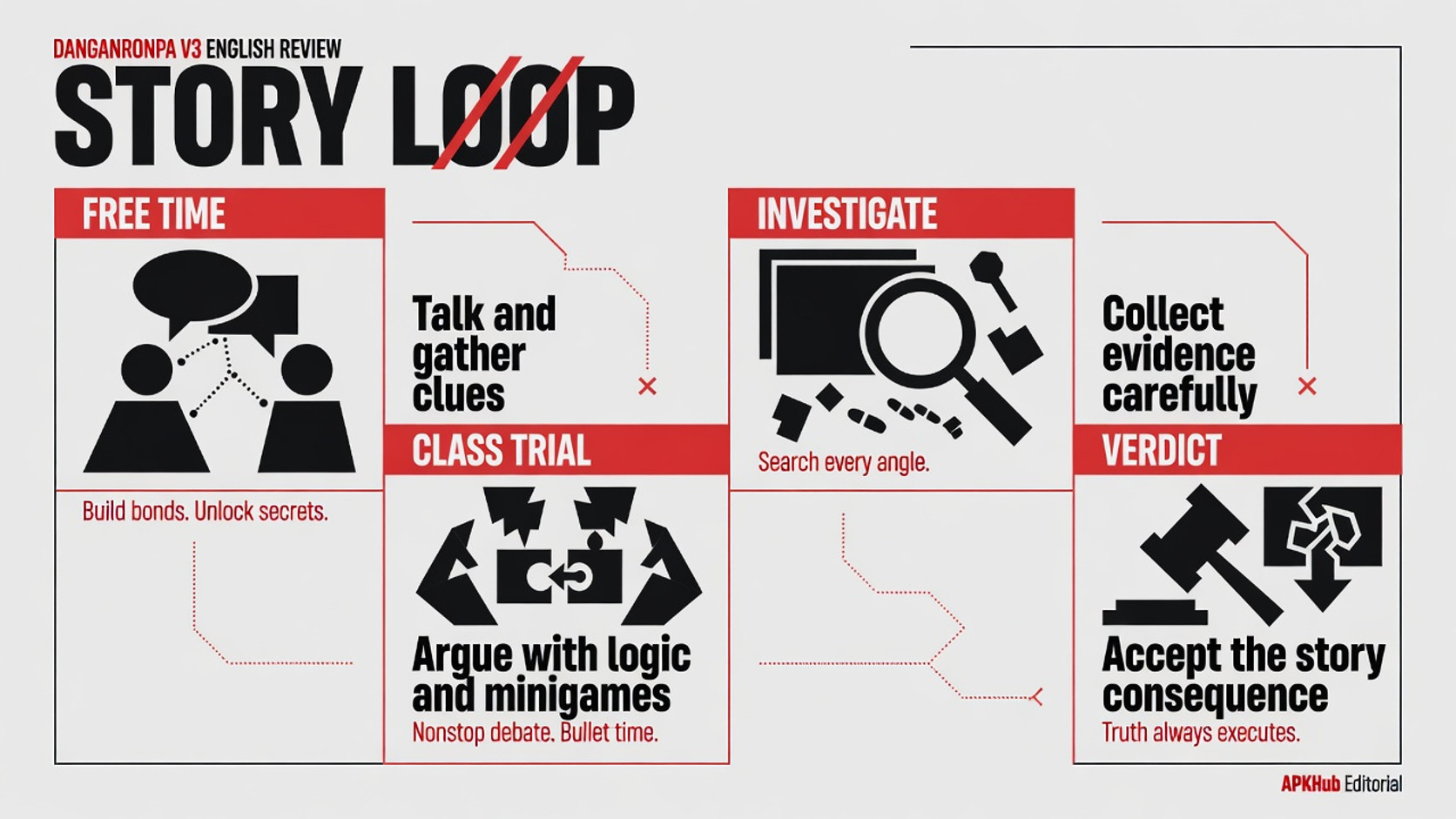
Editorial illustration: the campaign advances through exploration, evidence, trial debate, and story consequences.
Systems That Define the Experience
2.5D presentation. Characters and objects sit in a planar-yet-depth environment with dramatic camera work. The style is part of the identity: theatrical, sharp, and designed to sell tension rather than realistic simulation.
High-speed deductive action. Trials are not only menus. You aim truth bullets at contradictory phrases, keep rhythm in minigames, and manage attention while multiple voices argue. Missing a beat can cost progress inside the debate, so comfort with timing tools matters as much as reading skill.
Lies and Debate Scrums. V3 expands trial logic beyond pure contradiction spotting. You may need to lie strategically against statements that are not simple falsehoods, and group “scrum” debates split the cast into opposing sides. That raises both drama and cognitive load. Note names, motives, and which piece of evidence covers which claim. Mental notes alone are easy to lose across a long trial.
Character gallery and extras. Side content such as sprite and line galleries rewards completionists after the main path. They do not replace the need to finish cases carefully; treat them as post-chapter tools rather than the reason to install.
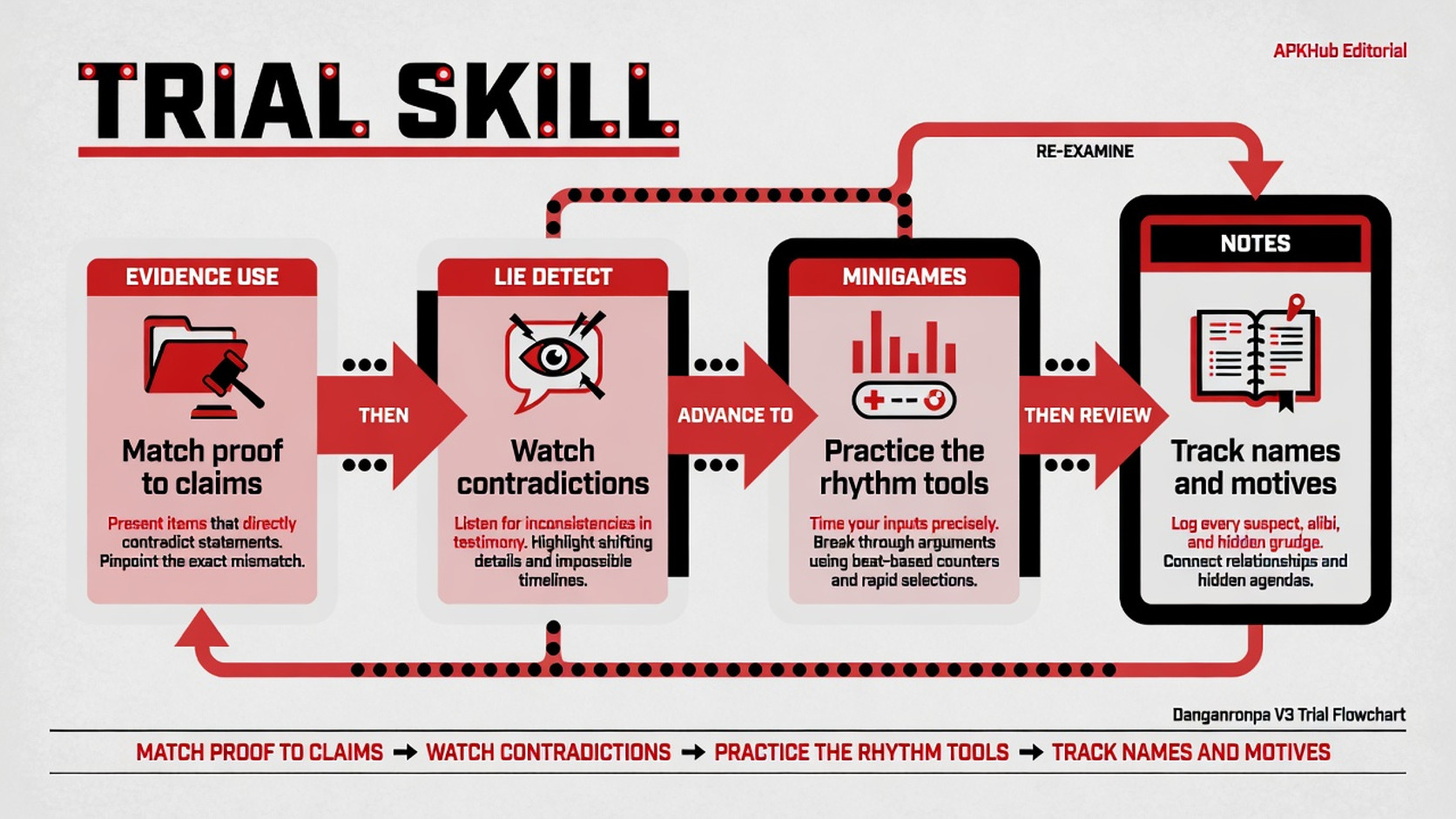
Editorial illustration: trial skill is matching proof to claims while managing new debate systems.
A Better Way for Beginners to Start
Do not binge the entire first chapter in one exhausted sitting unless you already know the series. Read free-time conversations with intention: pick a few classmates and learn their voices so later accusations feel grounded. During investigations, examine thoroughly even when the game seems to push forward; missing a single clue can make a later minigame harder than it needs to be.
In trials, slow your breathing when the music accelerates. The presentation wants urgency; your job is accurate selection. Use the tutorial for an unfamiliar trial mechanic and review its instructions before a timed sequence. Keep a simple offline note for names and key items if you take multi-day breaks between sessions.
Series newcomers should consider starting with the first game for context. V3 uses series conventions and later revelations that may affect how you experience earlier entries. Returning fans should still treat early chapters as a recalibration of the new lie and scrum systems rather than autopilot.
Progression Across the Killing-Game Campaign
Progress is narrative and systemic at once. Clearing a chapter unlocks the next pressure wave, new social options, and deeper cast relationships. Free-time investment should be deliberate: bonds can matter emotionally and, in series tradition, can influence support context, but they should not distract you from finishing the active case’s investigation.
Difficulty and text pace should match how you process dialogue-heavy games. If English voice or text density feels overwhelming, lower the session length rather than forcing a marathon trial while tired. Save before major trial sections and after successful clears. The campaign is long enough that careless save habits create avoidable frustration.
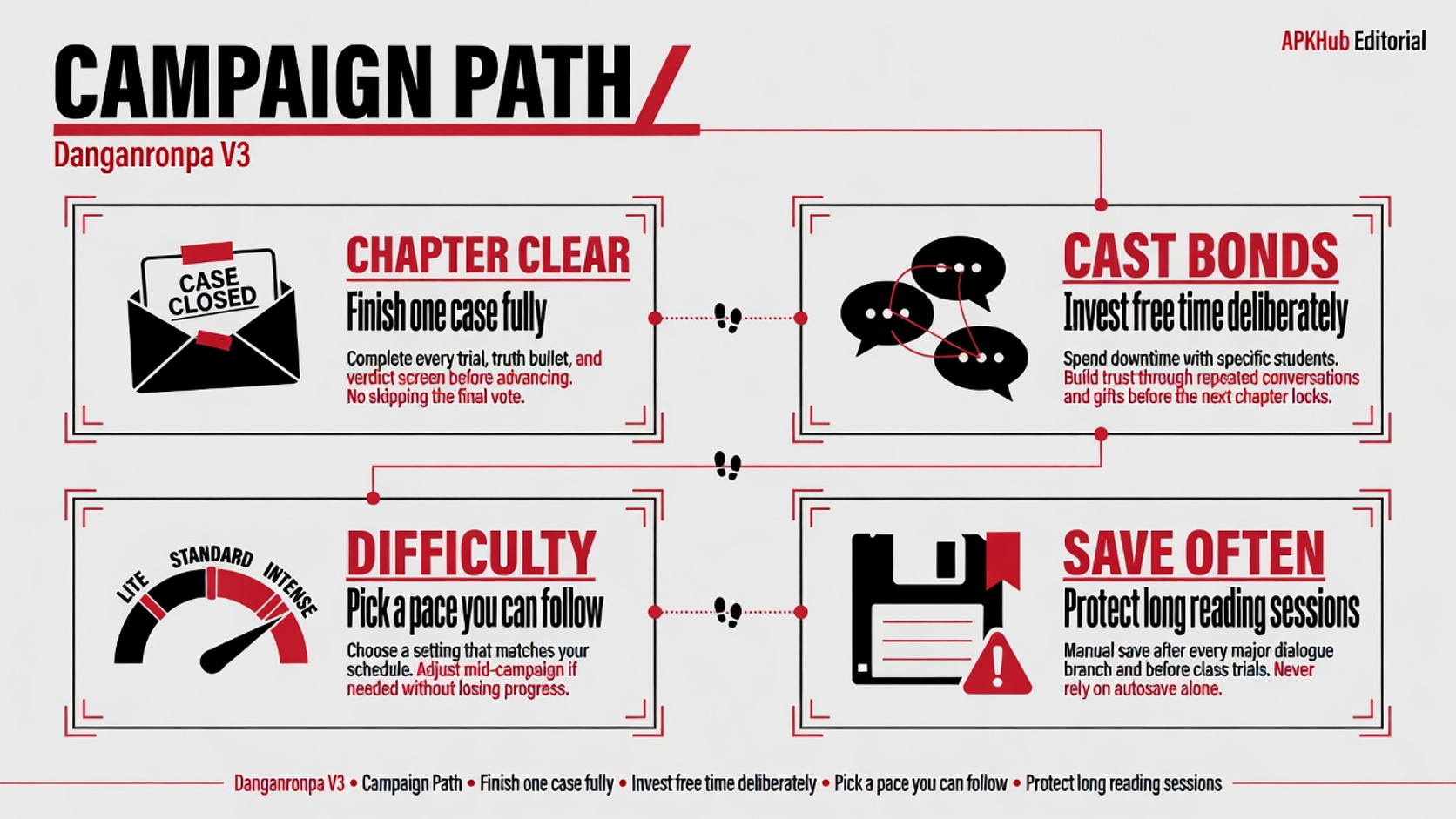
Editorial illustration: one finished case at a time is healthier than rushing the whole killing game.
Who It Fits
Danganronpa V3 fits players who enjoy visual novels, courtroom-style deduction, stylish presentation, and dark narrative twists. It rewards careful reading, tolerance for theatrical tone, and interest in multi-stage mystery structure. Fans of the series looking for the mobile release of this specific entry will find the Class Trial focus intact.
Who It Does Not Fit
It does not fit children, players seeking light comedy only, or anyone uncomfortable with murder-game premises. It is also a poor match for people who want short action rounds without long dialogue, or who need a free-to-play loop of daily missions and ads. If you bounce off text-heavy games or rhythm-adjacent trial minigames, the signature mode may frustrate more than it thrills.
Strengths and Weaknesses
Strengths
- Investigation-to-trial structure delivers a complete mystery cadence per chapter.
- Class Trials mix logic with energetic minigame presentation.
- New systems such as strategic lies and Debate Scrums refresh series veterans.
- Distinct 2.5D style sells atmosphere without relying on photoreal graphics.
- Current Play listing lists no ads and no in-app purchases for this package.
Weaknesses
- Mature themes make the game unsuitable for kids and sensitive players.
- Long dialogue and multi-phase trials demand real time and attention.
- Minigame timing can interrupt pure reading flow for some players.
- Story intensity and twists may overwhelm series newcomers who expected a lighter mobile adaptation.
- Large narrative games still need storage, battery, and save discipline on phones.
Monetization and Risks
As of 2026-10-23, the Play facts for this package list neither ads nor in-app purchases. That is a meaningful contrast with many mobile mysteries that gate chapters. Still verify the live store page and payment settings on your account before install, because storefront labels can change by region or update. The primary risk is content suitability, not a paywall mid-trial: players should opt in with clear eyes about dark subject matter.
Privacy policies and permissions still deserve a normal Android review at install time even when the commercial model looks premium-style.
Install Notes
Confirm package jp.co.spike_chunsoft.DRV3. The current listing specifies Android 8.0 or newer and warns that some devices remain unsupported. Prefer a device with comfortable reading size, reliable storage, and headphones if you care about fully voiced trial sections. Download over a trusted network, then confirm that saves behave as you expect after a force-close. Set a personal content boundary before chapter two: if the tone is already too heavy, it will not become softer.
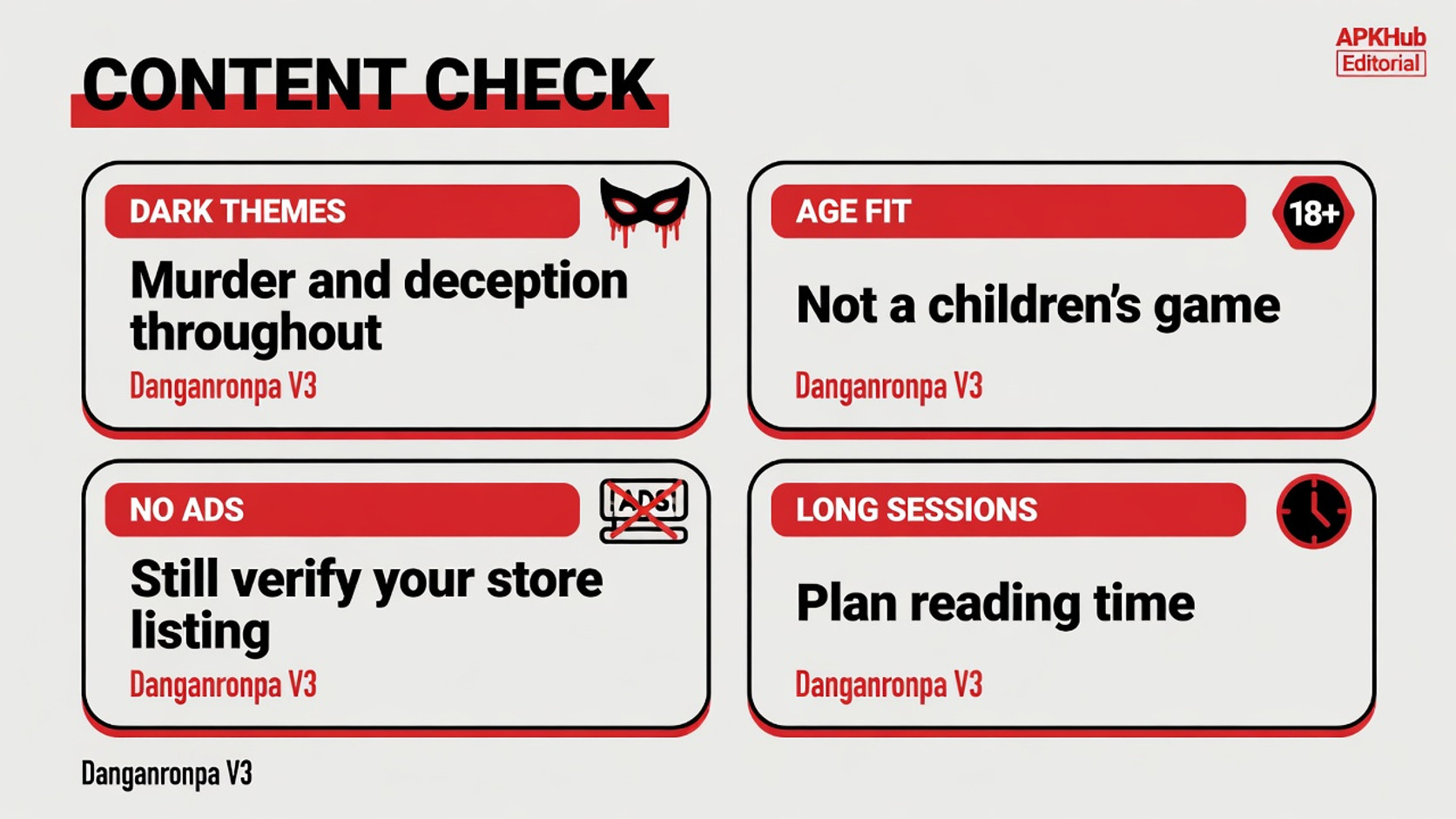
Editorial illustration: treat age fit and session length as seriously as any technical requirement.
Final Verdict
Danganronpa V3 on mobile is a full killing-game visual novel built around investigation and Class Trials, not a simplified kids’ spin-off. When you want stylish deduction, theatrical tension, and chapter-scale story consequences, it delivers a coherent campaign loop. When you want light entertainment or a family-safe download, it is the wrong product entirely. Go in for the trials and the writing, save often, and respect the content warning as part of the recommendation—not a footnote.


