
Human Fall Flat Review: Physics Comedy Where Clumsy Climbing Is the Puzzle



Human Fall Flat is a light-hearted physics platformer set in floating dreamscapes. You control a soft, uncoordinated human whose hands grab, climb, push, and flail until a puzzle yields—or until gravity stages another fall. The Google Play listing presents it as a solo experience or online multiplayer for up to four players, with free new levels added over time and no ads or in-app purchases flagged on the scrape used for this review. Confirm monetization and multiplayer requirements on the current store page before you install.
This Human Fall Flat review focuses on how the physics loop creates both comedy and strategy, how co-op changes the puzzle language, and who will enjoy that deliberate clumsiness on a phone or tablet.
The Core Loop: Grab, Climb, Push, Recover
Each dream level is an open-ended space filled with ramps, levers, vehicles, walls, and objects that respond to force. You do not jump with arcade precision. You aim limbs, hold grips, and negotiate weight. A boulder on a catapult, a stack of boxes, or a wobbly bridge can all become solutions if you treat them as tools rather than scenery.
The loop is simple to describe and messy to execute:
- approach an obstacle and decide whether to climb, shove, or recombine objects
- commit both hands (or one hand and a teammate) to a grip or push
- move carefully so momentum does not undo the setup
- fall, laugh, and rebuild the plan with better information
Multiple routes through a level reward exploration. A “correct” solution is often any solution that respects the physics. That flexibility is the game’s personality: ingenuity matters more than perfect timing.
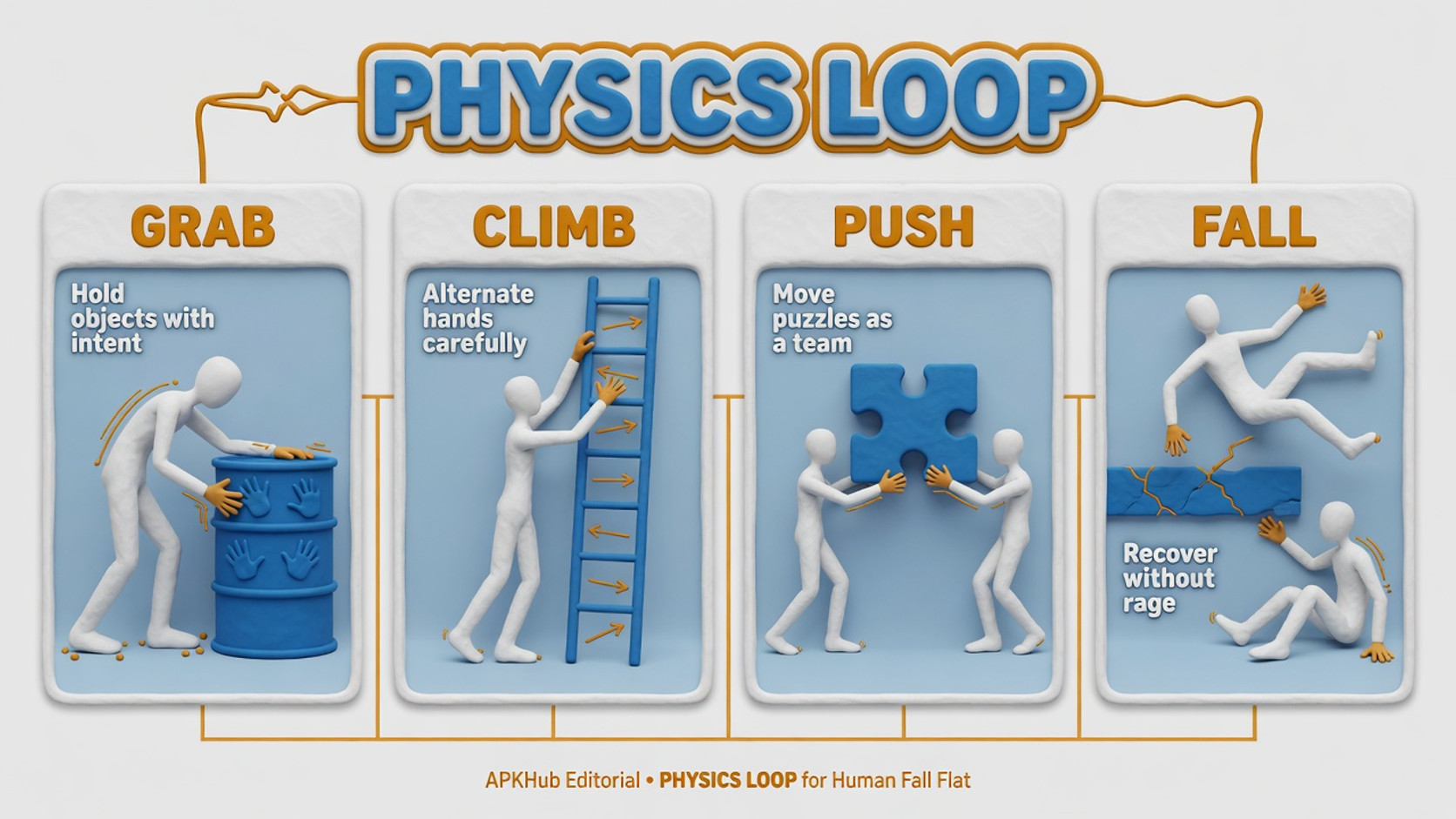
Editorial illustration: the puzzle is not a button prompt—it is how you apply force with unreliable limbs.
Where Solo Play and Co-op Diverge
Solo sessions teach patience. You learn to climb hand-over-hand, park objects so they cannot roll away, and leave yourself a recovery path if a climb fails. Solo also makes every drop personal: there is no friend to catch the plank or hold a door.
Online multiplayer for up to four players transforms the same levels into collaborative construction—and sometimes into friendly sabotage. Two players can form a human ladder, ferry an object that is too awkward for one, or stage a coordinated push. Communication becomes a mechanic. Calling “hold the left side” or “stand on the pressure plate” turns a slapstick sandbox into a miniature engineering project.
Set group rules early if you play with friends. Agree whether the session is pure cooperation or whether light chaos is welcome. Physics comedy is fun until one person repeatedly knocks the team’s progress off a cliff without consent. Host etiquette matters as much as grip strength.
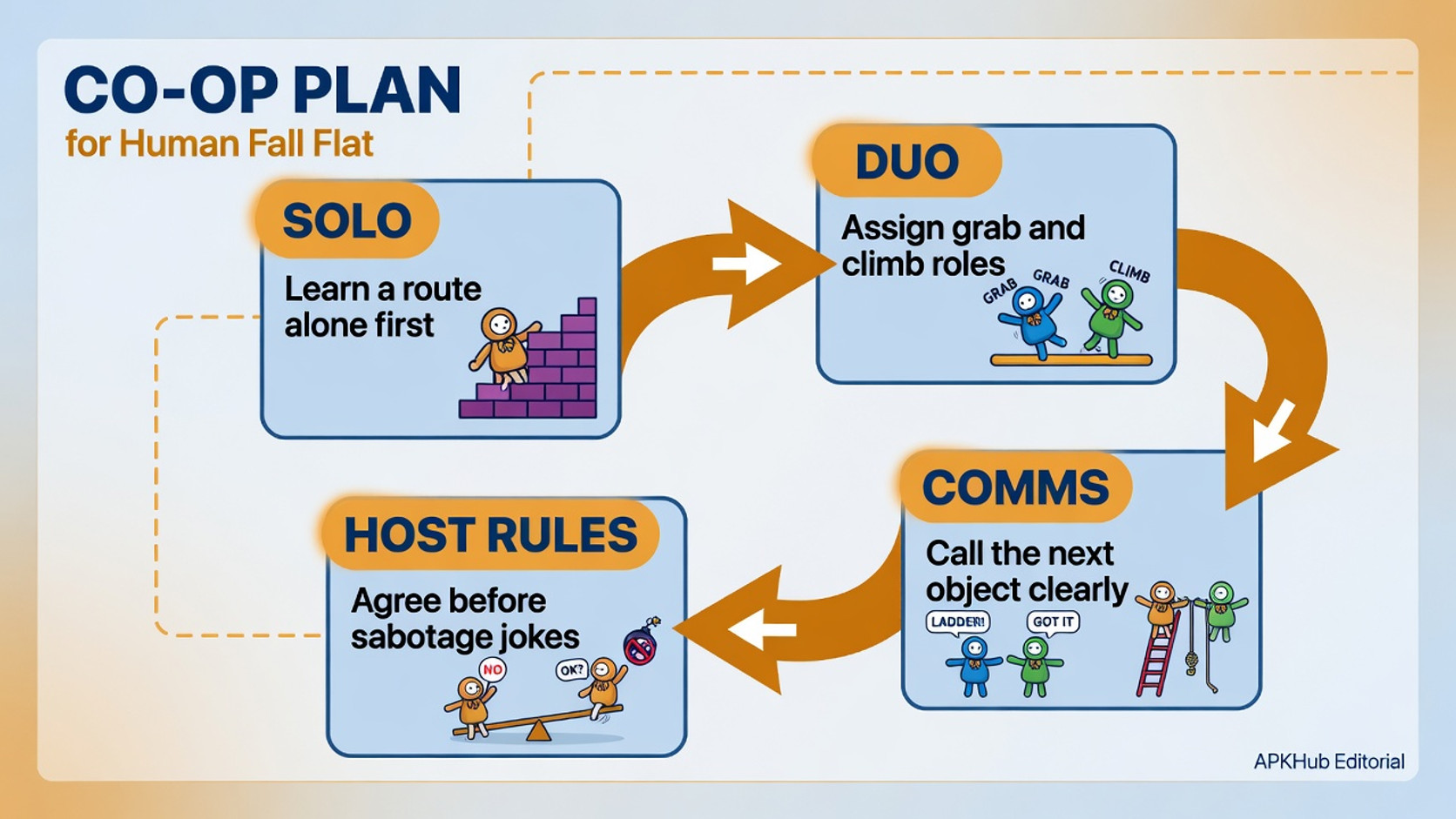
Editorial illustration: assign grab, climb, and spotter roles so four players solve more than they sabotage.
A Smart First Session
Spend the first session learning the control feel rather than racing level completion. Practice:
- grabbing a fixed ledge and alternating hands without letting go of both at once
- pushing a large object in a straight line instead of spinning it
- climbing a short wall, pausing mid-grip, then finishing the ascent
- recovering after a fall without thrashing the camera or controls
If you plan to play co-op, run one level solo first so you understand the intended geometry and can climb without repeatedly resetting the group’s setup.
Progression Across Dreamscapes
Levels change the toolkit without abandoning the same body physics. Mansions introduce basic climbing and furniture puzzles. Castles and industrial spaces add height, machinery, and longer fall consequences. Snowy or slick environments change traction. Night or themed dreamscapes alter visibility and mood. Free post-launch levels, when available on your build, function as bonuses rather than a live-service treadmill.
A practical progression map looks like this:
- master stable climbs and short pushes in early dreamscapes
- attempt multi-step object puzzles that require parking tools mid-route
- try vehicle or machine interactions once basic grips feel reliable
- invite co-op for levels that benefit from parallel roles
- treat newly added free levels as optional side trips after the base set
Because routes are open-ended, completion can mean finding an exit once or replaying for a cleaner solution. Choose the goal that matches the session.
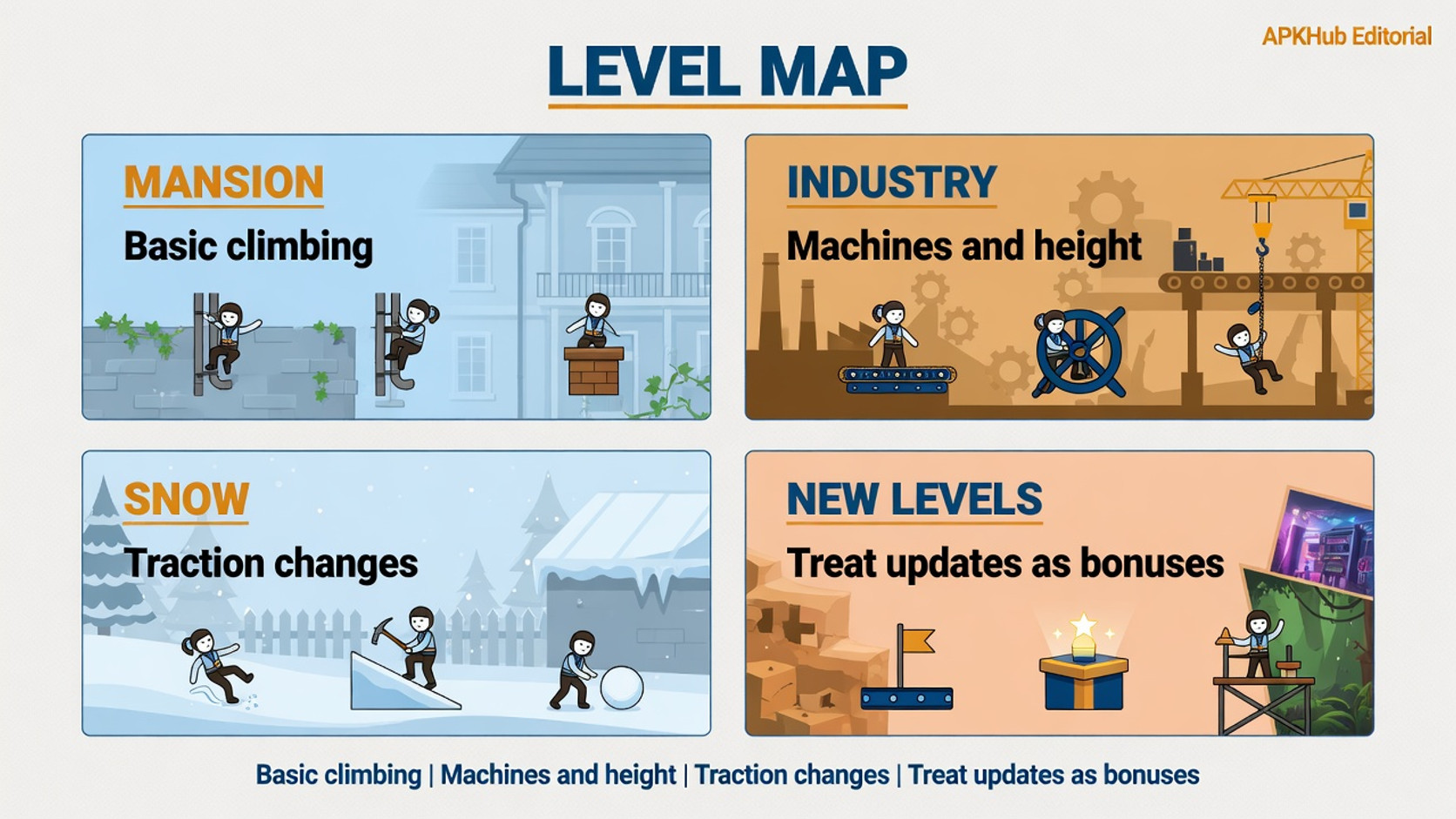
Editorial illustration: each environment reuses the same clumsy body with a different set of toys and surfaces.
Controls, Comfort, and Session Design
Touch controls can feel imprecise until muscle memory forms. Small inputs beat frantic thrashing. Co-op needs a stable network, while solo exploration is calmer. Plan each session around one level or objective, and stop if camera motion or repeated falls become uncomfortable.
Monetization and Product Notes
On the Play facts scrape used for this package, Human Fall Flat did not flag ads or in-app purchases. That is a meaningful product signal for a physics platformer that already sells the experience through gameplay rather than energy timers. Still treat store labels as time-sensitive: re-check the current Google Play listing for ads, purchases, size, and multiplayer requirements on your device and region.
Online features still require storage and network access. Review current data-safety and privacy materials before signing in.
Who Should Play Human Fall Flat?
Human Fall Flat is best for players who enjoy experimental physics, open-ended puzzle routes, and co-op comedy with friends. It fits groups that can tolerate clumsy controls as the point of the joke. Solo players who like environmental problem-solving will still find substantial value once the grip language clicks.
It is a weaker fit if you want precise platforming, competitive ranking pressure, or instant mastery. Players sensitive to motion or easily frustrated by repeated falls should sample short sessions first.
Strengths and Weaknesses
Strengths
- Distinct physics comedy that still rewards real puzzle thinking
- Solo and multiplayer (up to four) share the same level language
- Multiple routes encourage creativity over a single scripted solution
- Free level additions, when available, extend the dreamscape set
- Scrape showed no ads or IAP—verify on the live listing
Weaknesses
- Controls can feel soft until practiced
- Co-op without communication can become chaotic noise
- Falls that are funny once can frustrate on the tenth retry
- Network quality matters for the best multiplayer sessions
- Camera and motion comfort vary by player and device
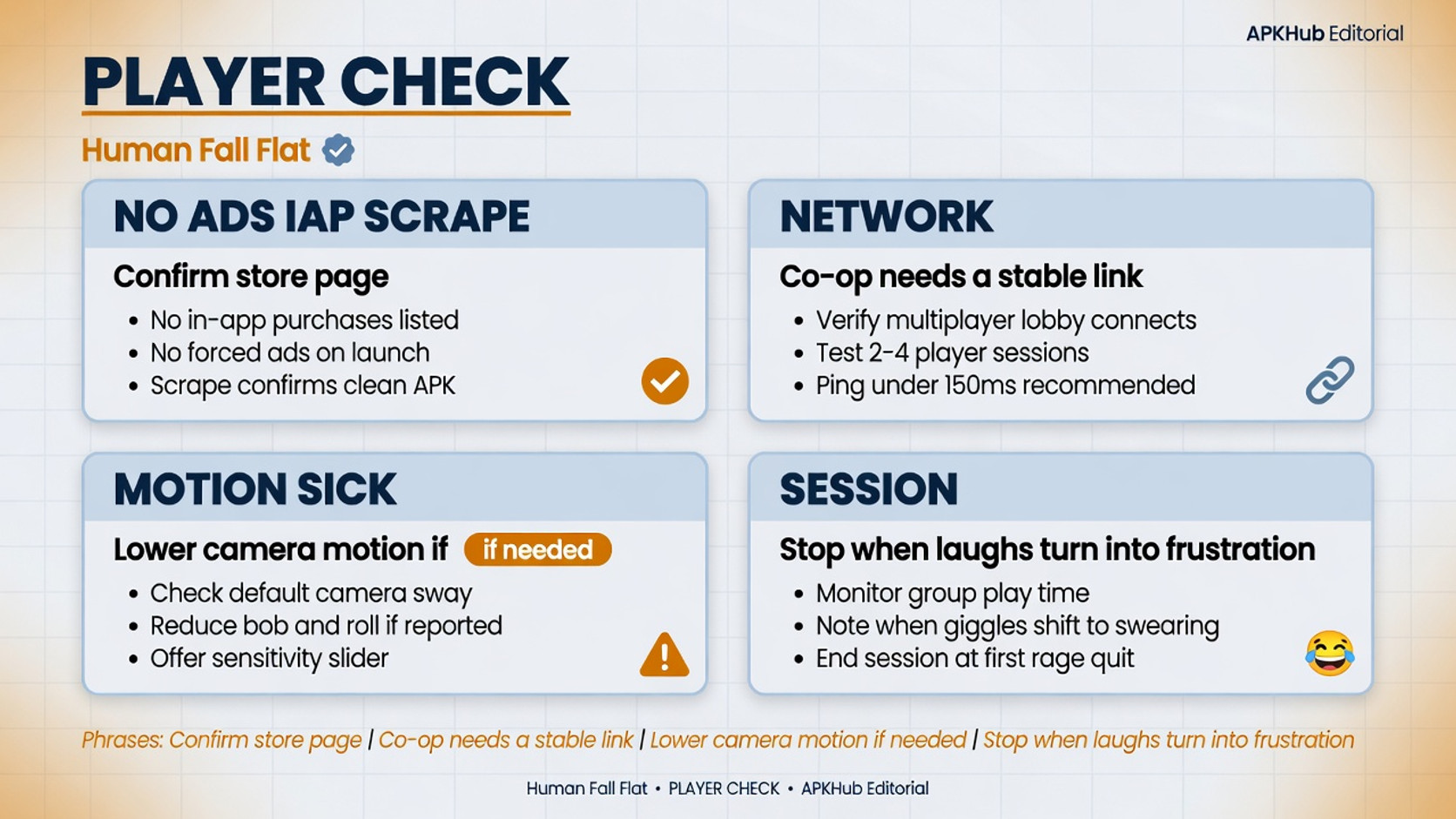
Editorial illustration: confirm store labels, network needs, motion comfort, and a stop point before another dreamscape.
Final Verdict
Human Fall Flat succeeds because its main character is intentionally imperfect. Every climb, shove, and rescue is a small negotiation with mass, friction, and gravity. Solo play is a quiet physics workshop; multiplayer is a comedy of errors that can also produce clever teamwork when roles are clear.
Play it for the solutions you invent, not for a leaderboard fantasy. Learn to grip with intent, recover without rage, and invite friends only after the basic climb feels readable. With expectations set around clumsy controls and co-op etiquette, Human Fall Flat remains one of the most distinctive physics party-platformers available on Android.


.webp?x-oss-process=image/resize,w_80/format,webp)