
Minion Rush Review: An Endless Runner Built on Costumes, Bananas, and Short Bursts

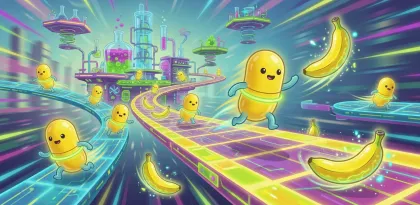

Minion Rush is Gameloft’s endless runner set in the Despicable Me world: you dash forward, switch lanes, dodge traps, and scoop up bananas while costume powers and mission goals give each run a sharper purpose. As of 2026-08-11, the Google Play listing marks the product as containing ads and in-app purchases, and it still promotes offline play for main features alongside regional competition modes.
Sessions can last under a minute or stretch into a high-score chase. Costumes, locations, missions, ads, and store prompts determine whether it stays a light arcade break or becomes a collection treadmill.
The Core Loop: Read the Track, Then Decide What the Run Is For
Forward motion is automatic. You swipe or tap to change lanes, jump, slide, and react to hazards that arrive faster as the run lengthens. Bananas act as the primary collectible; power-ups and temporary boosts change how aggressively you can chase them.
Strong runs treat the track as information, not decoration. Look past the obstacle currently under your feet and plan two beats ahead. A banana line that forces a late lane change into a trap is a net loss. A slightly poorer banana path that keeps a clear escape lane is usually the better play, especially when a mission only needs distance or survival rather than a perfect pickup score.
Continue prompts after a collision create a second decision layer. Before spending currency or watching a rewarded path, ask whether the run still has a clear objective. Ending a messy attempt and restarting with a costume that matches the goal often beats forcing a salvage.
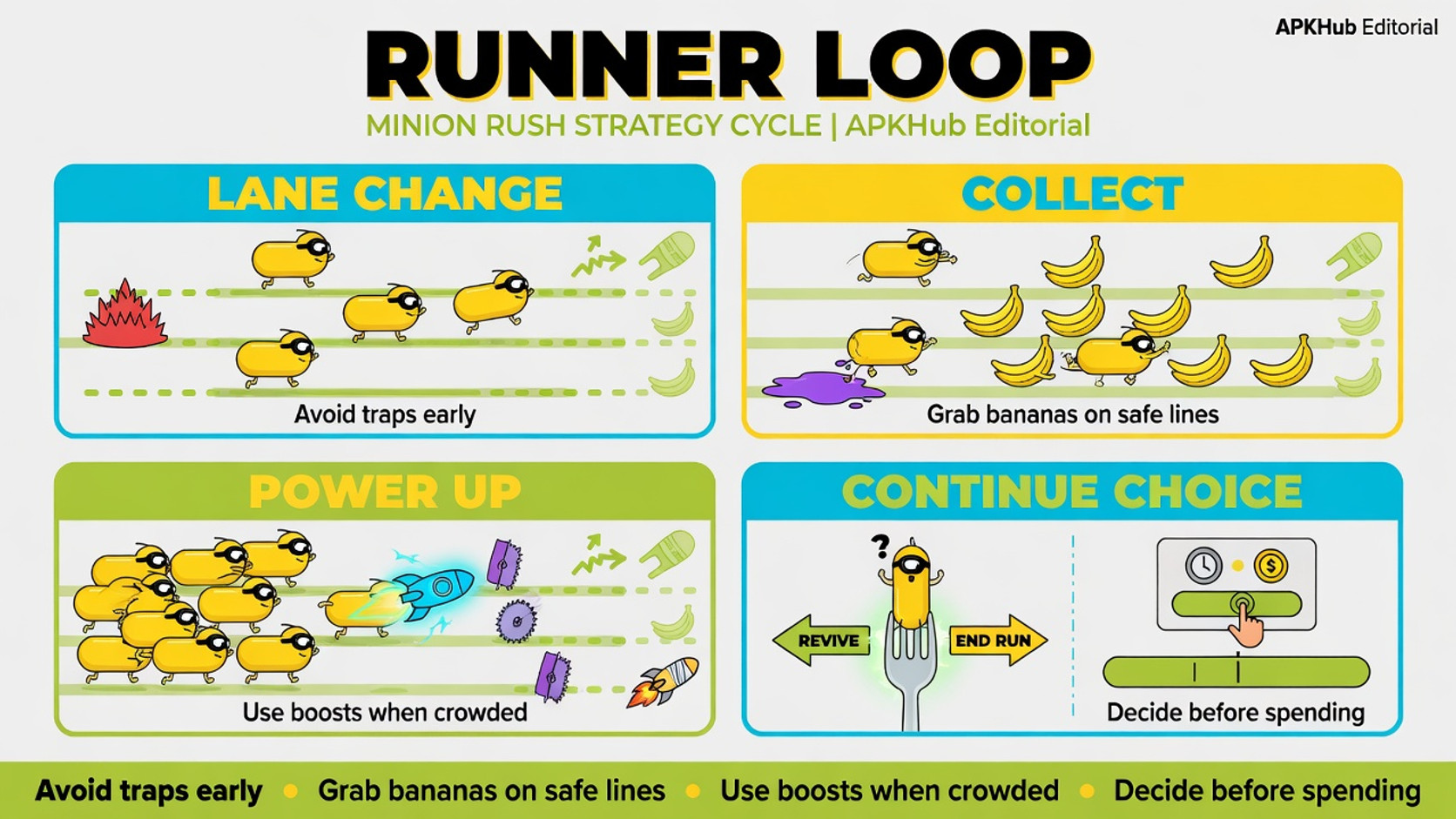
Editorial illustration: the core loop is dodge, collect, and decide whether to continue a run.
Systems That Matter: Costumes, Locations, and Mission Pressure
Costumes are more than cosmetics. The store description frames them as loadouts with skills such as extra speed, better banana gains, or special transformations. That turns the wardrobe into a strategy menu. When a mission asks for distance, prioritize mobility and survival. When the goal is a banana total, favor collection bonuses and safer center-lane lines. Event-focused outfits only pay off if you already understand the objective; unlocking them without a plan creates noise rather than power.
Locations change obstacle vocabulary. Headquarters corridors, villain lairs, and themed environments reuse the same swipe grammar but recombine traps, ramps, and sightlines. Learning a location means learning which lanes are dangerous early and which power-ups appear when density spikes. The competitive Top Bananas Room sits on top of this base loop for players who want regional or global score pressure; treat it as an optional high-focus mode rather than the default way to play after a long day.
Read the mission first, then pick a location and costume. Ignoring it is valid when you only want a quick arcade break.
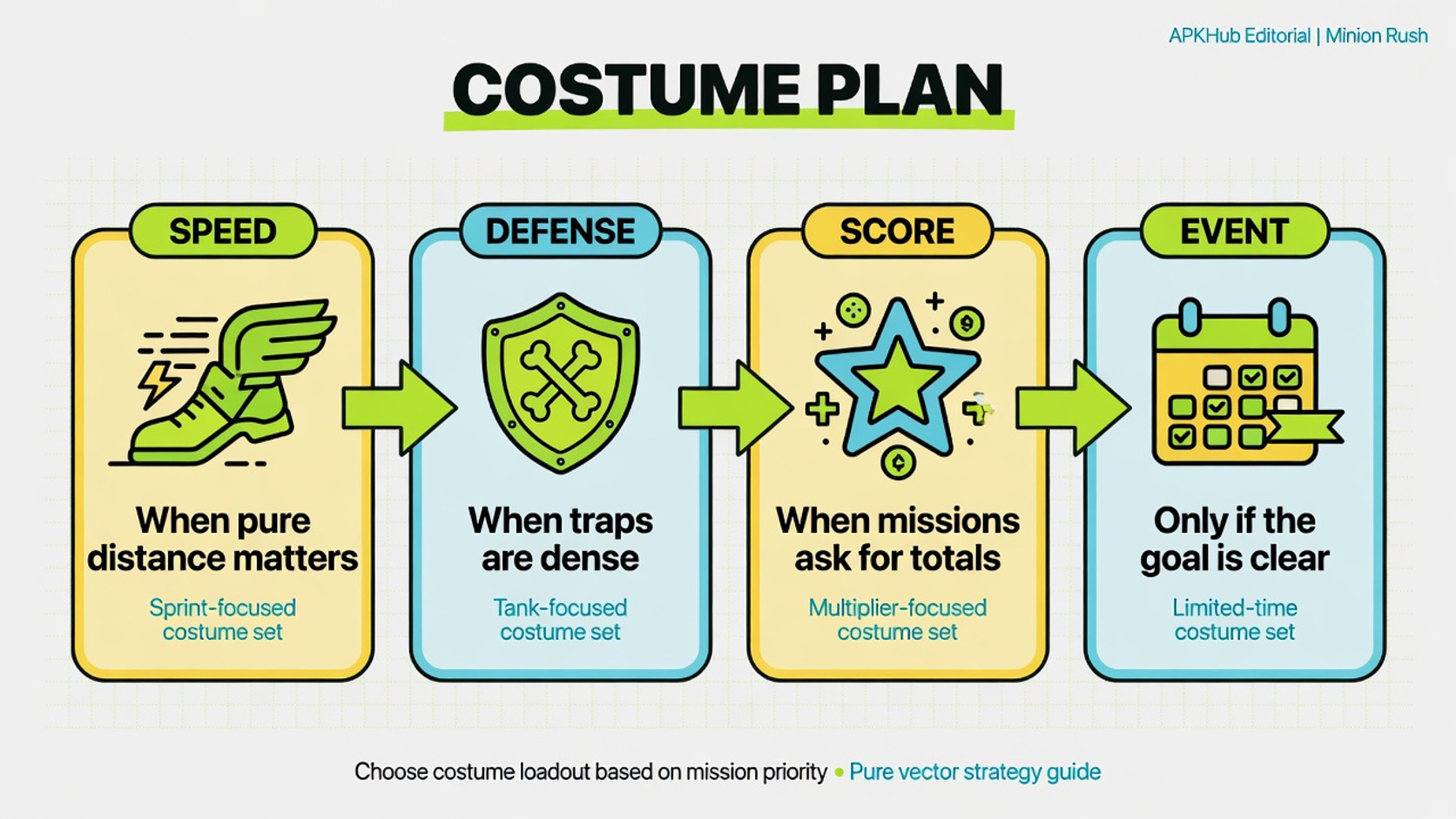
Editorial illustration: costume skills should match the mission, not only the look of the outfit.
A Better First Session for Beginners
Spend the opening minutes on track reading, not store browsing. Run one familiar location until lane changes, jumps, and slides feel automatic.
Next, choose one mission. For bananas, avoid risky side lines; for distance, ignore pickups that force collisions. Equip one costume that supports the goal rather than testing several new powers at once.
On a shared device, enable purchase authentication before a child can reach the store from a continue screen.
Progression Without Turning Every Event Into Homework
Progression comes from route reading, costumes, familiar locations, and missions. Use one short-term goal, such as a daily mission, and one long-term goal, such as learning a new location’s traps.
Events and seasonal presentations can make the game feel urgent. Urgency is a product design choice, not a personal obligation. When focus drops, stop. A shorter clean run teaches more than a long session filled with accidental purchases and frustrated continues.
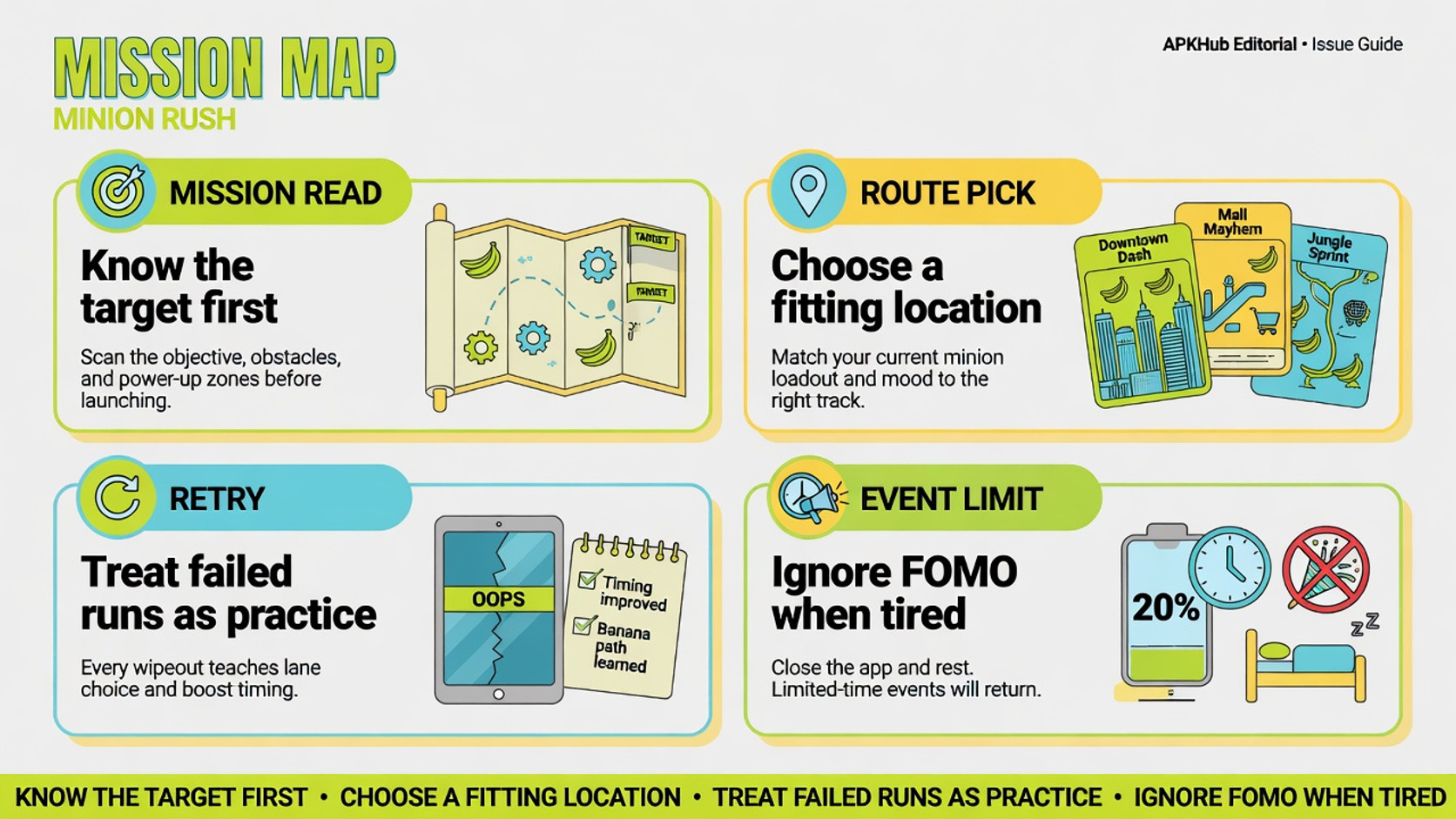
Editorial illustration: missions work best when you pick a route and accept retries as practice.
Who It Fits
Minion Rush fits players who want a bright, instantly readable endless runner with short sessions, costume variety, and light mission structure. It also suits households that already enjoy the franchise tone and want offline-friendly arcade play for main features, provided an adult reviews ads and purchases first.
Who It Does Not Fit
It is a weaker match for players who want a story campaign with fixed levels, deep combat systems, or a premium experience free of advertising pressure. Anyone who dislikes score chases, continue prompts, or licensed character cosmetics will exhaust the novelty quickly. Competitive room modes also demand more concentration than a casual family handoff usually allows.
Strengths and Weaknesses
Strengths
- Controls and goals are understandable within a single short run.
- Costumes create meaningful loadout choices beyond pure cosmetics.
- Multiple locations refresh obstacle patterns without rewriting the rules.
- Main features are presented as playable offline on the current listing.
- Mission and score modes support both quick breaks and focused attempts.
Weaknesses
- Ads can interrupt the free-play rhythm when connected.
- In-app purchases and continue decisions need firm household controls.
- The endless structure becomes repetitive if you only chase raw distance.
- Event and collection pressure can overshadow pure track skill.
- Licensed presentation does not replace the need to review privacy and permissions on the current build.
Monetization and Risks
As of 2026-08-11, Google Play lists Minion Rush with ads and in-app purchases. Advertising frequency can vary by region, version, and consent state; do not assume a video or older review still describes the current schedule. Optional purchases may cover cosmetics, currency, or convenience—read the exact product text before paying, and do not assume one purchase removes every ad surface forever.
The store description warns that disabling password protection can lead to unauthorized purchases. On any shared or child-facing device, keep authentication on. Review Gameloft’s privacy notice and the Play data-safety panel at install time rather than trusting a third-party summary.
Install Notes
Confirm the package identifier com.gameloft.android.ANMP.GloftDMHM before installing. Leave storage headroom for updates and additional location content. After install, test airplane-mode behavior if offline play is important to you: the listing promotes offline main features, but ads, competition rooms, and store functions can still depend on connectivity. Set a session stop point—one mission, three clean runs, or a fixed timer—before handing the device to a child.
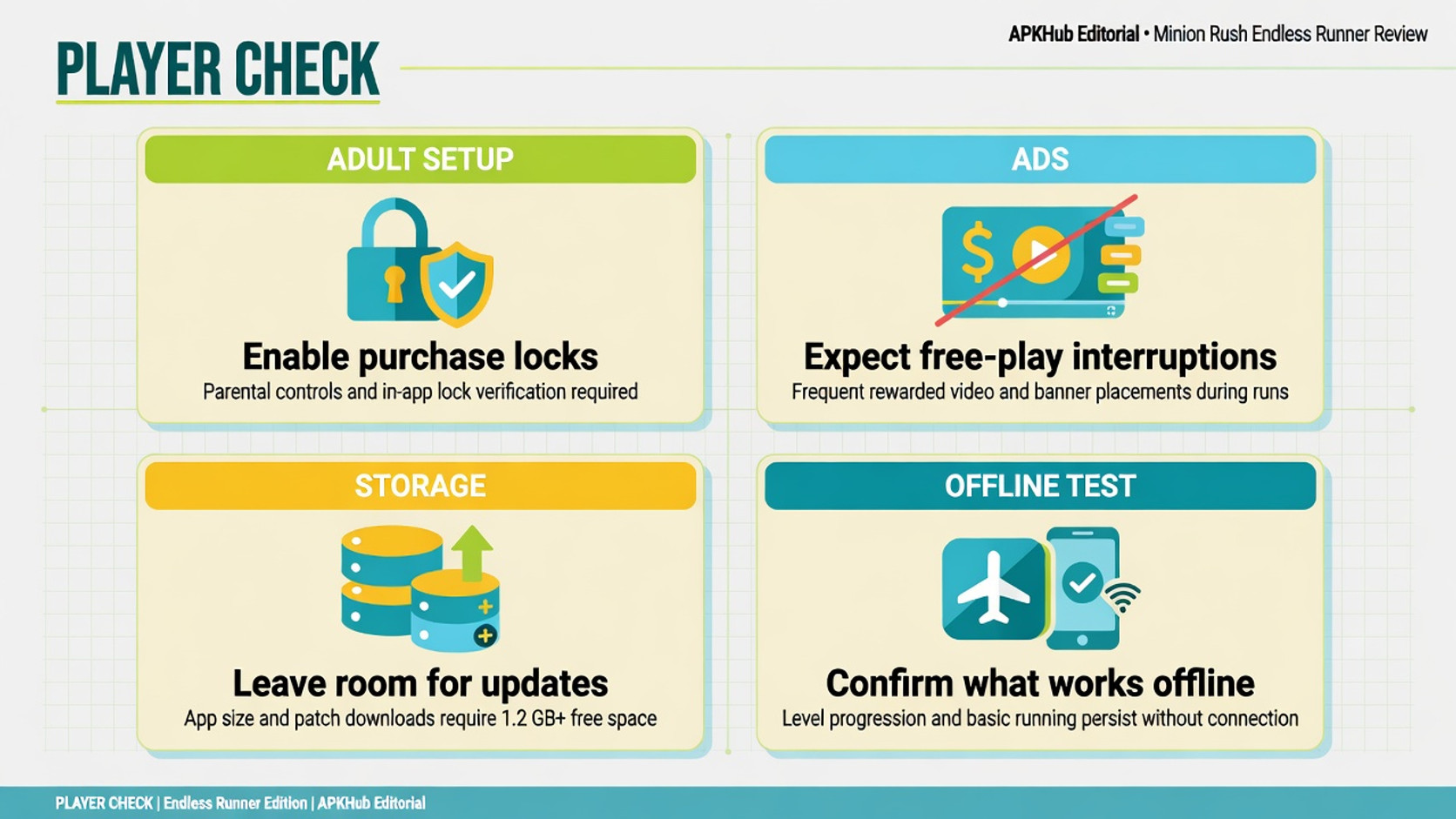
Editorial illustration: adult setup, ad expectations, and offline checks protect the fun of short runs.
Final Verdict
Minion Rush succeeds when you treat it as a track-reading arcade game first and a costume collection second. Lane discipline, early hazard reads, and mission-matched outfits produce better sessions than raw spending or endless continues. With purchase locks enabled and expectations set around ads, it remains a polished, high-energy endless runner that is easy to start and still skillful enough to reward attention.


.webp?x-oss-process=image/resize,w_80/format,webp)