
Monument Valley Review: Impossible Architecture You Solve by Turning the World



Monument Valley is ustwo games' paid puzzle adventure about silent princess Ida, impossible monuments, and paths that exist only after you rotate a piece of the building. You drag a gear, a column, or a staircase until two ledges that should not meet suddenly do, then you walk Ida across the optical trick. The Google Play listing used for this review prices the base game at $3.99 in the United States store, also lists Play Pass access, and flags in-app purchases. Those purchases are the Forgotten Shores chapter pack; Ida's Dream is described on the listing as available now.
This Monument Valley review focuses on the turning-the-world loop, how the chapters pace wonder instead of difficulty spikes, and who will be happy with a short, complete monument rather than a live-service puzzle ladder.
The Core Loop: Look, Twist, Walk, Arrive
Each screen is a monument that is also a machine. Ida walks on a tap. Crow People occupy some paths. Sacred geometry sits at the end of a chapter like a quiet apology. The puzzle is rarely a timer and almost never a hidden inventory item. It is a question: which surface is actually connected once the camera lies?
The loop:
- survey the monument without touching anything
- twist one control and watch which platforms move together
- walk Ida to the new connection before you undo the twist
- use a second control only when the first geometry is stable
- step onto the next floor and let the music resolve
The listing's design pitch is accurate: inspired by minimalist 3D, optical illusions, and palaces. Easy to pick up. Best with headphones because the audio reacts to your turns. That last point is not decoration. A click when a path seats itself is part of the solution language.

Editorial illustration: the path appears only after the monument admits two floors are the same line.
Chapters, Crow People, and Forgiveness
The base campaign is a sequence of self-contained monuments. Early chapters teach a single trick: rotation, a moving bridge, a hidden underside. Later chapters combine tricks without turning the game into a gotcha contest. If you are stuck, you are usually over-turning. Put the structure back to a readable shape and look for the one ledge that wants a friend.
Crow People are obstacles with personality rather than enemies to grind. They block a tile or patrol a loop. You wait, redirect, or fold their floor away. The listing's line about "outsmarting the enigmatic Crow People" is the whole combat system, and it is enough.
Ida's story is told in short titles and quieter revelations about monuments and forgiveness. It is not a novel. Players who want a long narrative should not expect one. Players who want a mood will find that the last pedestal lands harder than the word count suggests.
Forgotten Shores is the paid expansion: eight additional chapters, per the listing. It is the correct purchase if you finished the base game and still want more of the same language, not a different genre. Ida's Dream, originally a charity extra, is listed as available; check the current client to see whether it appears in the chapter list without a second fee.
Cloud save and tablet support are listed features. Use restore purchases if you reinstall. The settings control for that restore is the official path, not a support ticket about lost DLC.
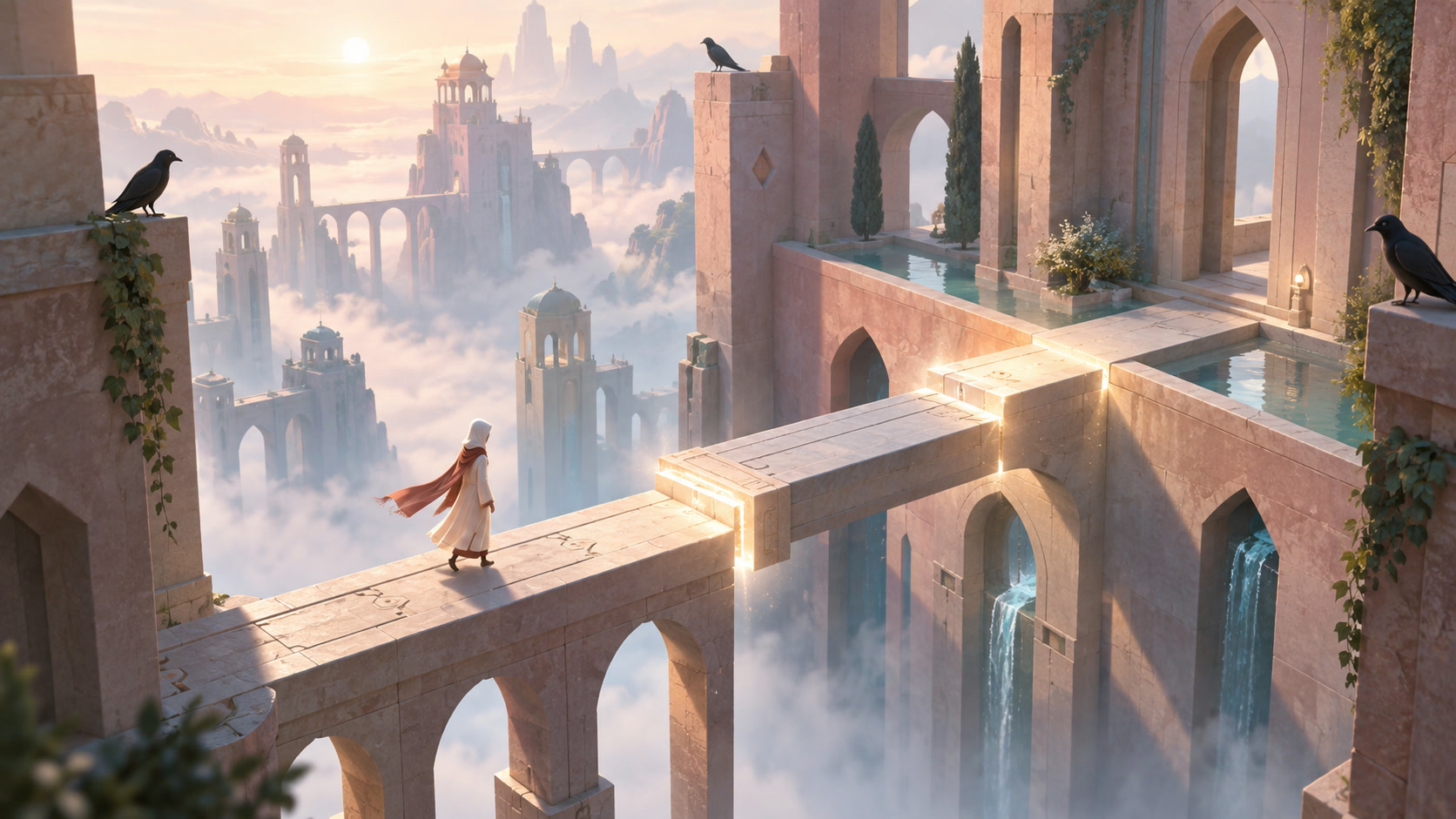
Editorial illustration: each chapter teaches one new lie about space, then combines the earlier lies.
Spending Risk: A Paid Box With One Clear Extra
The commercial model is the opposite of a gacha RPG. You pay once for the base monuments. The listing shows in-app purchases and a "Digital Purchases" content rating. Forgotten Shores is a separate, named chapter pack. There is no energy timer and no random banner on the scrape used for this review.
That still deserves a check:
- confirm the $3.99 price and any regional tax on the live page
- decide whether Forgotten Shores is worth a second payment after you finish the base set
- Play Pass can cover the base game while you are subscribed; leaving Play Pass can change access
- restore purchases after reinstall before you buy again
Do not expect a live calendar of new free monuments. Updates on this scrape were general bug fixes. The sequels, Monument Valley 2 and Monument Valley 3, are separate products on the same developer page.
The data-safety panel on the listing states no data shared with third parties, collection of app info and performance, encryption in transit, and that data cannot be deleted through the usual Play control. Read that panel if cloud save and privacy matter to you.

Editorial illustration: pay for a finished chapter list you can name, not for a roll of random floors.
How to Play It Well
Sit somewhere quiet. Use headphones. Play one or two chapters, then stop while the last shape is still in your head. Zooming and over-tapping Ida will not invent a path. If a puzzle feels unreadable, rotate slowly through the full range of the handle.
Tablet play is kinder to the architecture. Phones work; thumbs just cover more of the monument.
There is no leaderboard to beat. Completion is walking Ida to the end and, if you want, buying the shores. That brevity is a frequent complaint in older reviews and also the design. Monument Valley is an hour-scale artwork with an optional encore, not a hundred-level ladder.
Who Should Play Monument Valley?
Monument Valley is best for players who like calm spatial puzzles, museum-like presentation, and a story told in architecture. It is an easy recommendation for a shared tablet on a trip.
It is a weaker fit if you want combat, user-generated levels, or dozens of hours. Players who feel cheated by short premium games should look at the chapter list and the DLC description first, then decide.
Strengths and Weaknesses
Strengths
- Optical-illusion puzzles that stay fair
- Art and reactive audio are the gameplay, not a wrapper
- Touch controls match the one-gesture solutions
- Paid model with a named expansion instead of random IAP
- Cloud save and a restore-purchases path
Weaknesses
- The base campaign is short
- Forgotten Shores is another purchase if you want length
- Little mechanical variety outside spatial tricks
- No offline-mod or editor for people who want to build monuments
- Privacy panel notes data cannot be deleted via the usual control

Editorial illustration: listen first, twist second, and only buy Forgotten Shores after Ida's last pedestal.
Final Verdict
Monument Valley is still the cleanest argument for a premium mobile puzzle: a handful of monuments, a precise interaction, and a feeling that the world agreed to be impossible for you.
Buy it for the walk, not for a content treadmill. Finish the base chapters before you open the shop. If you still want the sea air of Forgotten Shores, that pack is a continuation, not a repair. Few Android games make a single rotated staircase feel like a secret the building was keeping.


.webp?x-oss-process=image/resize,w_80/format,webp)