
Papa's Freezeria HD for Android Review 2026: A Classic Tablet Time-Management Game That Still Works

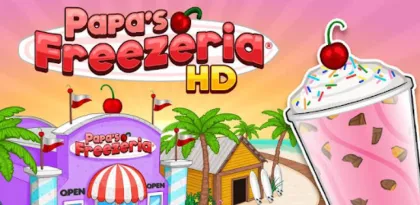

Papa's Freezeria HD takes a wonderfully simple fantasy—running a tropical ice-cream shop—and turns it into a demanding routine of order taking, pouring, mixing, blending, topping, serving, and cleaning up mistakes. The Android release was designed for tablets, with larger touch controls and a broader presentation than Papa's Freezeria To Go. More than a decade after its original launch, the game still demonstrates why Flipline Studios' restaurant formula became so enduring.
The appeal comes from precision under pressure. Every customer wants a specific sundae. Pour the wrong amount, blend too long, scatter toppings unevenly, or leave someone waiting, and the score reflects it. Strong service produces a steady chain of rewards.
Papa's Freezeria HD is also visibly an older title. It does not include the holiday calendar, Special Recipes, Food Truck, delivery orders, stickers, and expanded progression found in the newer Papa's Freezeria Deluxe on PC. Its interface was built around tablets rather than modern tall phones, and local saves require care when changing devices. Yet the core play remains sharp, cheerful, and refreshingly free of energy timers or an always-online live-service structure.
For Android tablet owners who enjoy score chasing, cooking games, and efficient multitasking, Freezeria HD is still easy to recommend. Phone players should look first at the To Go edition, while anyone wanting the most feature-rich version should compare the PC-only Deluxe release.

A Summer Job That Immediately Goes Wrong
The story is deliberately light. The player arrives at Calypso Island for a relaxing job at Papa Louie's oceanfront dessert shop. Papa leaves, tourists flood the island, and the new worker is suddenly responsible for the entire Freezeria. The premise provides enough personality to connect a sequence of workdays without slowing down the restaurant loop.
Players can choose Penny or Alberto or create a custom worker. Character creation includes hairstyles, colors, facial features, proportions, clothing, and accessories. Customization does not change how the restaurant operates, but it gives the long campaign a personal center. New clothes can be purchased or earned, and dressing the worker becomes another reason to continue beyond a perfect score.
The tropical setting keeps the pressure cheerful. Bright colors, exaggerated customers, and elaborate sundaes prevent the game from feeling like a serious simulation. Familiar routines gradually turn a crowd of cartoons into recognizable regulars.
There is no complex narrative twist waiting at the end. Progress is the story: a nervous employee becomes faster, the shop gains equipment, the lobby fills with decorations, ingredients multiply, and regular customers collect awards. The structure is comfortable precisely because it does not pretend to be something else.
Four Stations, One Continuous Puzzle
Every workday revolves around four connected areas. The Order Station receives customers and records their requests. The Build Station measures ice cream, syrups, and mixable ingredients. The Mix Station blends cups to the requested consistency. The Top Station adds whipped cream, sauces, sprinkles, candies, and the final cherry before the ticket is served.
None of these tasks is individually complicated. The challenge comes from overlap. While one cup blends, another customer enters. While a new order is being taken, the blender approaches its target. A finished cup waits for toppings while someone in the lobby becomes impatient. The player must remember which stage each ticket has reached and switch stations before a small delay becomes a cascade.
Order tickets can be arranged to support a personal system. Group new orders together, keep blending cups in another area, and move topping-ready tickets where they are easy to see. That physical organization is part of the strategy. Efficient players are not merely faster with gestures; they reduce the amount of attention needed to understand the queue.
The difficulty curve is effective because new variables arrive gradually. Early days teach pouring and blending with a limited menu. Later ranks add ingredients, larger cups, more demanding combinations, faster arrivals, and customers with high standards. The game becomes busy without changing its rules underneath the player.
Build Station: Accuracy Before Speed
At the Build Station, the goal is to pour the correct amount of ice cream and add the requested mixables and syrups. Touch controls make the process feel tactile. The player aligns ingredients, watches meters, and releases at the right moment. Small errors are visible in the final score.
Rushing is tempting when the lobby grows, but a badly measured foundation cannot be repaired by beautiful toppings. The smartest early habit is consistency: learn how quickly the gauge moves, read the entire ticket before starting, and avoid switching away in the middle of a critical pour.
Ingredients unlock over time, expanding visual variety without changing the basic interaction. That repetition is central to the genre. Someone seeking constant mechanical reinvention may find it monotonous; someone who enjoys mastery will notice improvement from one day to the next.
Mistakes can be discarded and rebuilt, but wasted time affects waiting customers. Deciding whether a flawed sundae is acceptable or deserves a restart becomes its own calculation. A minor imperfection may be better than making the entire queue late.

Mix Station: The Heart of Multitasking
The Mix Station creates most of the game's tension. Each cup needs to blend to a level shown on the ticket, while a meter above the blender tracks progress. Removing it too early or too late reduces the result. Multiple active machines turn timing into a small scheduling problem.
Upgrades make this station easier to manage. Timers improve awareness, and blender boosters accelerate a cup when used carefully. Holding a booster too long can overheat it, making impatience costly. Good upgrades reduce repetitive friction without playing the game automatically.
The Mix Station teaches a useful rhythm. Start longer blends first, take another order while the machine works, prepare the next cup, then return at the correct moment. New players stare at the meter and lose time elsewhere. Experienced players internalize the duration and treat blending as a background process.
This is where Freezeria HD feels most like a true time-management game rather than a decorating activity. The player is always deciding what can wait, what cannot, and which action creates the largest future delay.
Top Station: Presentation Becomes Performance
The Top Station asks the player to reproduce the ticket's final arrangement. Whipped cream needs coverage, sauces should flow evenly, and loose toppings should be distributed in the expected pattern. Larger tablet controls help because placement matters across the width of the cup.
Topping is satisfying because the result is immediately visible. A carefully layered sundae resembles the order and earns a strong score; a rushed pile looks obviously wrong. The gestures are forgiving enough for casual play but precise enough to support improvement.
The station can become the bottleneck when several mixed cups arrive together. Ticket organization again matters. Completing one cup cleanly is often better than bouncing between several partially topped desserts. The game rarely requires superhuman reflexes; it rewards a calm process under increasing pressure.
Touchscreens suit the activity better than a mouse in some respects. Dragging streams of sauce and scattering ingredients feels natural. That physical pleasure is one reason the HD edition remains enjoyable despite its age.
Customers, Closers, and the Food Critic
Papa's Freezeria HD includes 80 customers with distinct orders and patience levels. Returning visitors create familiarity. Once a regular's favorite sundae is memorized, the player can begin preparing before the order is fully processed, saving valuable time.
Good service fills a customer's star gauge. Strong performance leads to Bronze, Silver, and Gold customer awards, increasing points and tips while encouraging consistency across many visits. A poor score can reset progress toward the next award, so even familiar customers remain relevant.
Closers arrive at the end of the day and judge more strictly. Their presence changes the emotional rhythm: the shop may be nearly finished, but the final order carries greater risk. Jojo the Food Critic appears periodically with a changing request. Impressing him earns a Blue Ribbon displayed in the lobby and temporarily improves tips.
These systems give personality to repetition. The player is not serving anonymous waves; each customer represents an ongoing record. Perfectionists gain long-term goals, while casual players can simply enjoy unlocking new faces.

Progression, Tips, and Shop Upgrades
Each successful day produces points and tips. Points raise the player's rank, introducing customers and ingredients. Tips fund practical upgrades, lobby decorations, furniture, and personal customization. Weekly paychecks ensure some forward motion even when service is imperfect.
The upgrade shop offers the best strategic spending. Door chimes make arrivals harder to miss, blender equipment reduces supervision, and other tools smooth the workflow. Buying convenience early can generate better scores and more tips later. Decorative spending offers a different advantage because entertained customers tolerate waiting more patiently.
Lobby design is more than cosmetic. Posters, furniture, flooring, wallpaper, and interactive objects affect how the waiting area feels and can support customer patience. Arranging the room provides a relaxed break between intense shifts. It also creates visible proof of progress when the core station graphics remain familiar.
The economy avoids the pressure associated with modern free-to-play design. The game is purchased upfront, and its progression is earned through play rather than energy refills or recurring currency packs. That makes rank advancement feel slower than an instant unlock, but also more coherent.
Mini-Games, Clothing, and Achievements
Foodini's Mini-Games appear after workdays, using tickets earned through restaurant performance. Challenges such as Saucy Shot and Mitch's Mess change the pace and award furniture or clothing. They are short diversions rather than a separate campaign, but they prevent every session from ending on the same results screen.
The HD edition includes extensive clothing and worker customization. These rewards are primarily visual, yet they broaden the meaning of tips and mini-game success. Players who enjoy designing characters may spend as much time in the shop as optimizing blenders.
One hundred achievements provide a checklist for long-term completion. Some arrive through normal progress; others encourage specific actions, strong scores, customer mastery, or use of the game's side systems. Achievement hunters have reasons to continue after all major ingredients are familiar.
The reward structure is generous without becoming noisy. There are always several goals—next rank, next ingredient, another customer award, a useful upgrade, new clothing, lobby furniture—but the game does not constantly interrupt service with promotional events.
Difficulty, Repetition, and Session Length
Freezeria HD is accessible but not effortless. Early shifts are slow enough to teach each station. Difficulty grows through greater volume and menu complexity rather than arbitrary penalties. A weak day still grants experience and money, so failure rarely blocks progress completely.
Repetition is the central dividing line. The basic actions do not transform after several hours; players simply perform them under more demanding conditions with more ingredients. Fans interpret that as mastery. Others may feel they have seen the whole game once the four stations are understood.
The workday format suits short sessions. Longer play can become tiring because topping and pouring demand attention, but progress does not depend on a daily online schedule.
There is no competitive multiplayer or constantly refreshed endgame. Completion comes from unlocking content, collecting awards, earning achievements, decorating, and improving scores. That finite, self-directed structure feels pleasantly old-fashioned.
HD, To Go, and Deluxe: Which Version Is This?
The naming can confuse new buyers. Papa's Freezeria HD is the tablet-oriented edition covered here. Flipline's official page identifies it for iPad and Android tablets, highlighting touch controls, custom workers, 80 customers, more than 50 ingredients, furniture, clothing, upgrades, mini-games, and achievements.
Papa's Freezeria To Go was redesigned for smaller phone screens. It has different controls and content, including its own ingredient selection. A phone owner should not assume HD will be the most comfortable choice merely because “HD” sounds newer or more complete.
Papa's Freezeria Deluxe is the modern expanded edition for Windows PCs. It adds systems not present in HD, including holidays, seasonal flavors, Special Recipes, stickers, a Food Truck mode, delivery orders, unlockable customer outfits, score details, more customers, and higher-resolution presentation. Deluxe is the definitive feature set, but it is not the Android tablet game.
The original Flash version represents another historical release. Although all versions share the shop concept, progress and features should not be expected to transfer between them. Buy the edition that matches the device and desired content, not the title suffix alone.

Performance, Compatibility, and Offline Play
Papa's Freezeria HD was created for an older generation of Android tablets, so compatibility deserves verification. Google Play determines whether a device can install the current listing. Modern operating systems, unusual aspect ratios, and phones may produce a less ideal experience than the original tablet target.
The game is technically modest and should not challenge modern hardware when it runs correctly. Touch accuracy and screen size matter more than processor speed. A medium or large tablet gives tickets and topping areas enough room, while a small phone can make precision uncomfortable.
Core play does not revolve around an internet connection. That makes Freezeria HD suitable for travel, children using an offline tablet, or anyone tired of games that fail when a server is unavailable. Store authentication, installation, platform achievements, or external links may still involve Google services.
Progress is stored locally according to Flipline's Android privacy policy. That supports offline play but means players should not assume cloud synchronization or automatic migration. Before uninstalling, resetting a tablet, or changing devices, check whether the current Android setup exposes a supported backup route. Never erase an established save on the assumption that purchase restoration includes progress.
Privacy and Family Suitability
The game has a broad audience and uses cartoon food-service play without violence. Reading order tickets, planning tasks, and practicing timing can make it appealing for older children as well as adults. Younger players may need help with multitasking but can still enjoy character and lobby decoration.
Flipline's published Android privacy policy states that identifiable data is not collected by the listed apps and that progress is stored locally. The same policy is old and notes that some apps may include advertising or links, so families should review the live Google Play Data safety section and device permissions rather than relying only on a historic statement.
The paid-upfront format is a major advantage for family use. The core progression does not require repeated spending. Parents should still use Google Play purchase controls and inspect any external links available from menus.
Strengths
- Excellent four-station time-management loop.
- Tablet touch controls make building and topping satisfying.
- Eighty customers and more than fifty ingredients provide substantial progression.
- Custom workers, clothing, lobby decoration, mini-games, and achievements add variety.
- Upgrades create meaningful improvements rather than automatic victory.
- Paid, self-contained structure avoids energy timers and subscription pressure.
- Core gameplay works well offline.
- Cheerful presentation remains appealing after many years.
Limitations
- Designed for tablets, not modern small-screen phones.
- Older presentation and compatibility assumptions show their age.
- Repeated pouring, blending, and topping will not suit every player.
- Local progress may be difficult to transfer or recover.
- No modern Deluxe features such as holidays, Special Recipes, Food Truck, or delivery.
- No multiplayer or continuously updated endgame.
- Precise topping gestures can become tiring in long sessions.

Who Should Play It?
Papa's Freezeria HD is best for Android tablet owners who enjoy restaurant games, score optimization, tactile tasks, gradual unlocks, and cheerful repetition. It is easy enough for casual play but supports the precise routines that completionists enjoy. Existing Papa Louie fans will appreciate the characters and customization.
Choose the To Go edition if a phone is the primary device. Choose Freezeria Deluxe on Windows if the priority is the largest feature set and modern presentation. Skip HD if repetitive service loops feel like work, cloud saves are essential, or the device cannot install the official Google Play release.
Final Verdict
Papa's Freezeria HD for Android earns 8.3 out of 10. Its age is clear, but the central design remains excellent. The four stations create constant, understandable decisions; touch controls suit the sundae-building fantasy; and progression rewards both efficiency and personal expression. A complete paid game that works offline also feels increasingly valuable in 2026.
The score stops short of the series' best because the HD edition lacks the richer systems of Deluxe, targets tablets from an earlier Android era, and relies on local progression. Repetition is not a flaw accidentally left in the design—it is the design—so enjoyment depends on whether improving a familiar routine feels satisfying.
On the right tablet, Freezeria HD is still a delightful pocket of controlled chaos. Take the order, start the blender, watch the lobby, arrange the toppings, and discover that one more perfectly scored workday is difficult to resist.


