
Stickman Party Review: Four Players, One Screen



Stickman Party 234 MiniGames is a collection of short competitive games from PlayMax Game Studio. Its defining feature is local multiplayer for up to four people on the same Android device. The Google Play listing describes more than 50 mini-games, one-touch controls, solo play, offline support, and activities including tank battles, football, micro-car racing, running, bouncing, and color challenges. It also lists more than 500 million downloads, ads, and in-app purchases.
This is not an online service pretending to be a party game. Its best moments happen when several hands reach for the same screen and every round ends before anyone needs a tutorial.
The Shared-Screen Loop
Most mini-games use a single button or a very small control zone for each player. The rules change, but the physical arrangement stays understandable: choose a color, find your corner, and react faster than the people beside you.
That simplicity solves a common local multiplayer problem. Passing a phone back and forth turns competition into waiting. Stickman Party keeps everyone active at the same time. A race, tank duel, football round, or survival challenge can establish a winner in minutes.
The device matters. Four players on a small phone will block each other's view and may trigger accidental touches. A tablet is the ideal surface. On a phone, two-player rounds are usually more comfortable. Place the device flat, disable disruptive notifications, and make sure every player can reach a control without twisting the screen.
The games are deliberately readable rather than physically accurate. Cars slide, stick figures collide, and a single mistake can reverse the lead. That loose handling is part of the comedy. It is less successful when one player expects tournament precision from a shared touchscreen.
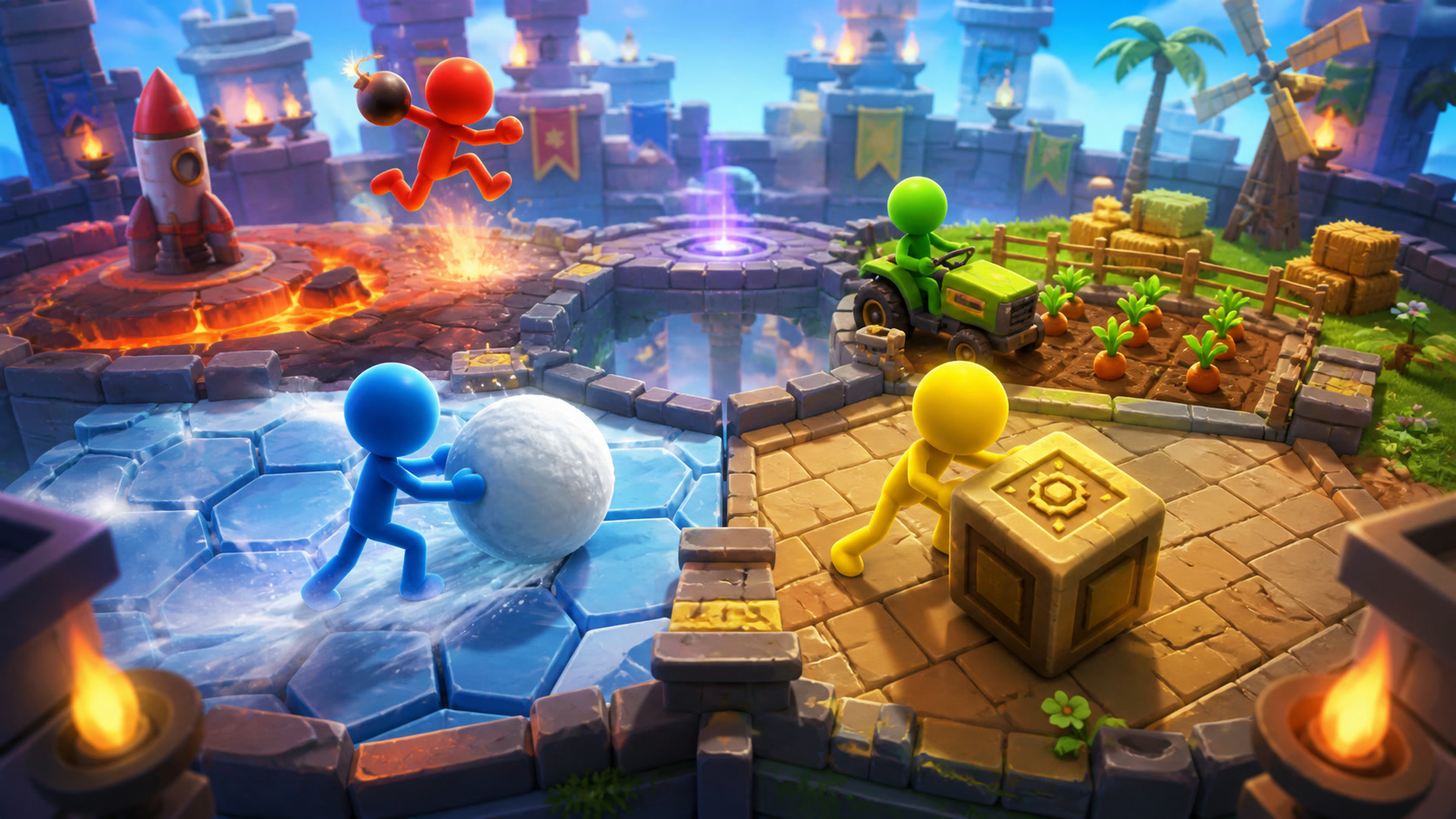
Editorial illustration: the hardware setup is part of the game when four people share one screen.
Variety Without a Long Tutorial
The Play listing names more than 50 games. Variety is the collection's main defense against repetition. A racing expert may lose the next tank round. A player who struggles with timing may win a simple territory game. Rotating modes stops one skill from controlling the whole session.
The strongest mini-games have three qualities:
- the objective is visible within seconds
- the controls create mistakes that feel funny rather than arbitrary
- the round is short enough to request an immediate rematch
Not every activity lands equally well. Some modes feel like simplified versions of familiar mobile games, and balance can vary between solo bots and human groups. The collection works better as a playlist than as fifty separate games to master. Mark five favorites, then add one unfamiliar mode between them.
Solo play is useful for learning controls and unlocking familiarity, but it is not the main attraction. Computer opponents cannot reproduce the negotiation, teasing, and improvised house rules that make local party games memorable. If you install it only for solo progression, the presentation may feel shallow.
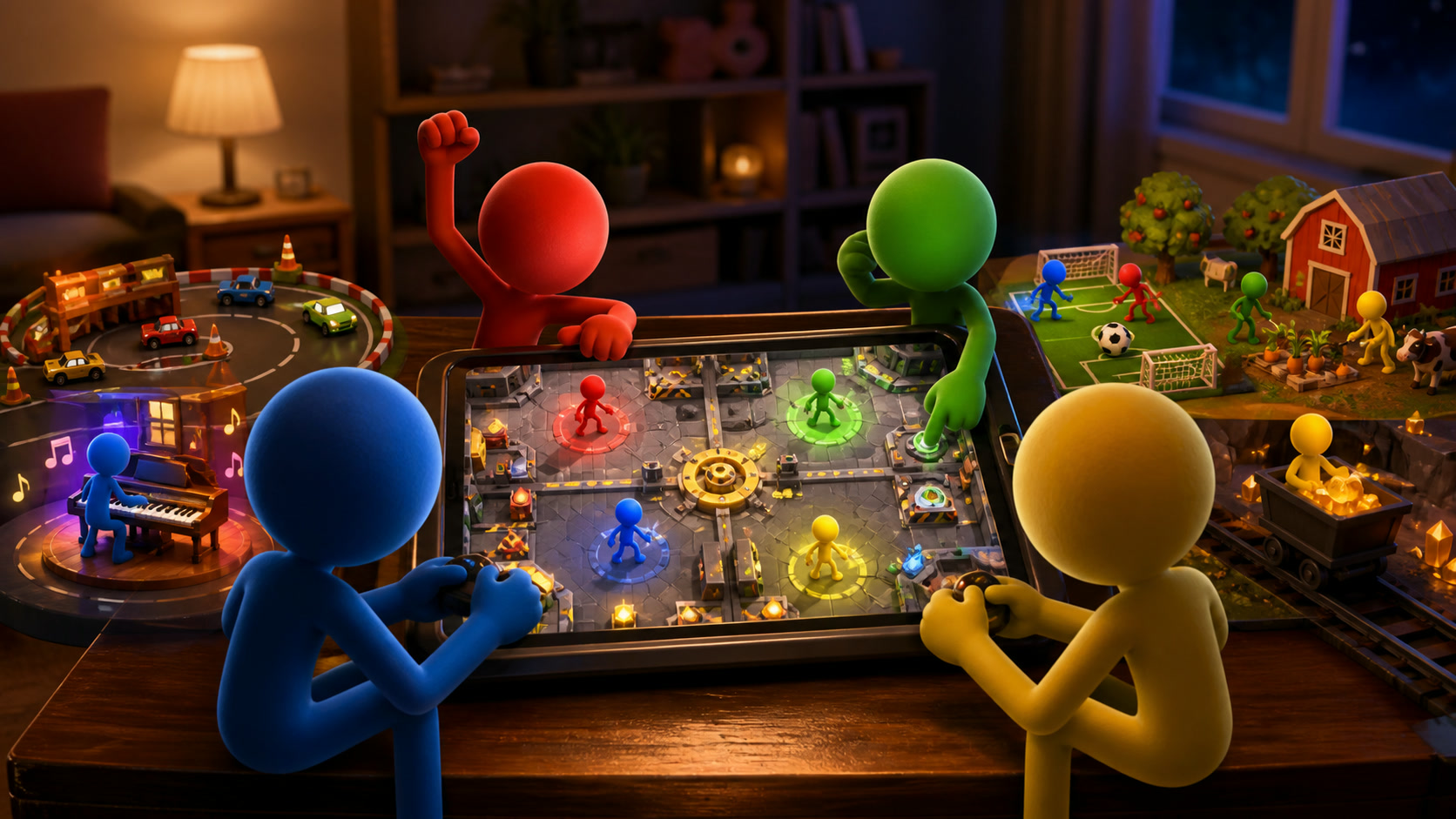
Editorial illustration: rotate the skill test so one strong player does not own the entire session.
Ads, Purchases, and Family Setup
Google Play marks Stickman Party as containing ads and in-app purchases. The store's Data safety disclosure also states that the app may collect and share several categories of data; players should read the current listing for version- and region-specific details. Offline support reduces the need for a connection during local play, but it does not erase the app's declared data or advertising model.
For a family session, open the app before handing over the device. Check which modes are immediately available, close unrelated screens, and decide whether purchases require a password. Do not let a child treat an ad reward as the required entry ticket for the next round.
The Everyone rating reflects mild content, not a guarantee that every advertisement shown by a third-party network will match a family's preferences. Device-level purchase authentication and supervised setup are practical safeguards.
Fairness also needs a human rule. Change seating positions after a few rounds, because a comfortable corner or dominant hand can matter. If ages and abilities differ, use teams or a best-of-three playlist rather than a long cumulative score that makes early losses permanent.
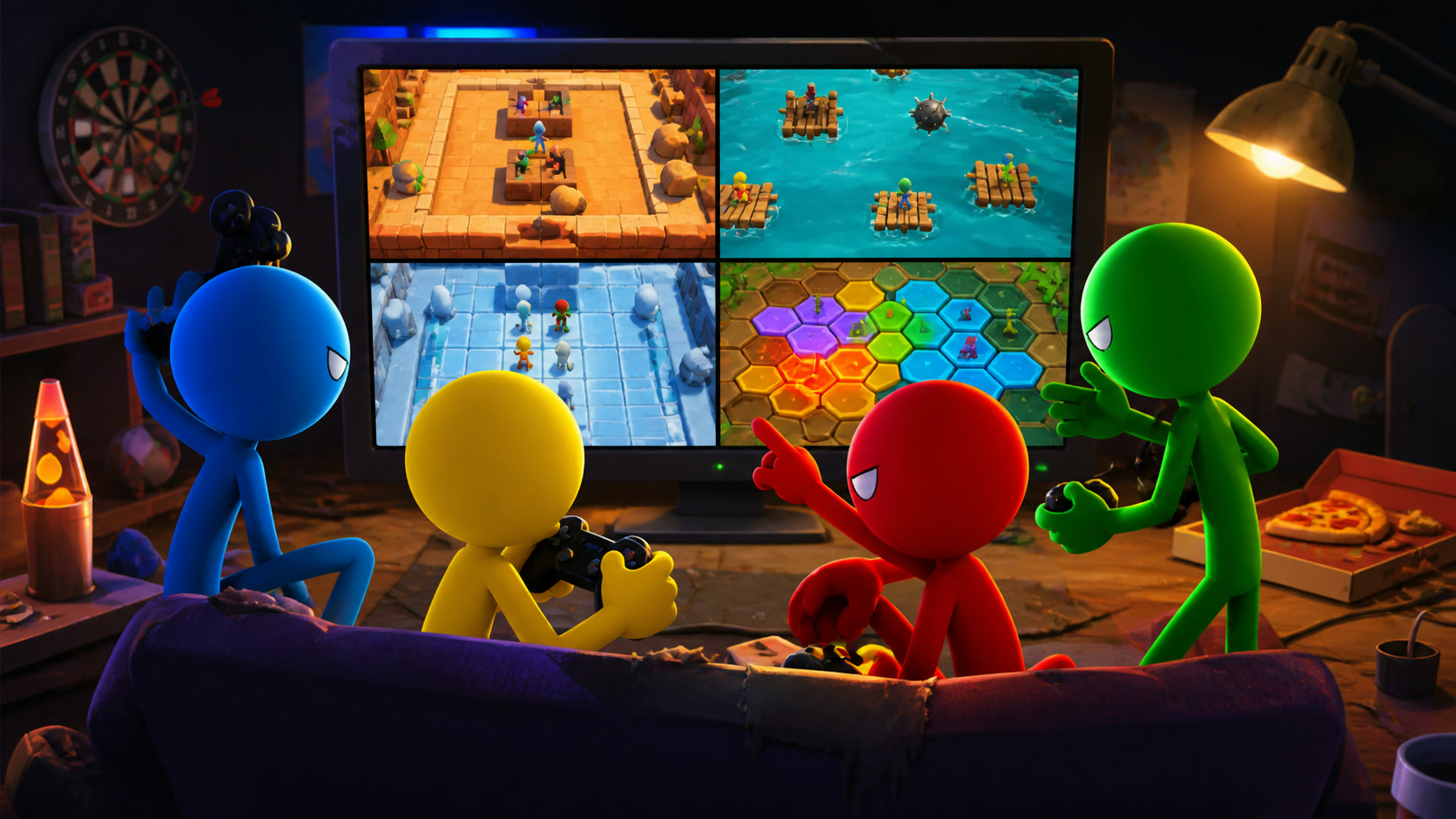
Editorial illustration: a two-minute setup prevents ads, notifications, and awkward corners from deciding the party.
Building a Good Party Session
Start with a cooperative explanation round. Nobody keeps the score; everyone learns the button. Then play three different modes and count one point per win. After the playlist, let the last-place player choose the next game.
This format avoids the two worst outcomes: one player farming the same mode, and the group spending longer in menus than in matches. Keep the total session around twenty or thirty minutes. Short local games are most effective when people stop while they still want a rematch.
If the screen becomes crowded, reduce the player count instead of blaming touch detection. Clean the display, remove a thick case if it destabilizes a tablet on the table, and lock screen rotation. Practical friction looks like game imbalance when everyone is tapping at once.
Who Should Play Stickman Party?
Stickman Party is a strong fit for siblings, couples, families, travel groups, and anyone who wants local competition without controllers. It is especially useful on a tablet and in places where Wi-Fi is unavailable or unreliable.
It is a weaker fit for players seeking online ranked matchmaking, deep solo campaigns, precise esports controls, or premium presentation. The art is functional, the rules are compressed, and the value comes from the people around the screen.
Strengths and Weaknesses
Strengths
- Up to four local players on one device
- More than 50 short mini-games
- Simple controls and fast explanations
- Offline local play
- Strong variety for mixed skill levels
Weaknesses
- Four-player phone controls can feel cramped
- Mini-game quality and balance vary
- Solo play loses much of the social appeal
- Ads interrupt the party rhythm
- Shared touch input is less precise than separate controllers

Editorial illustration: choose Stickman Party for the room around the device, not the depth inside it.
Final Verdict
Stickman Party understands that local multiplayer succeeds through low friction. One device, one button per person, and one-minute rules are enough to create a loud room. The large playlist keeps rematches fresh, while offline support makes the collection easy to carry.
Use a tablet when possible, set purchase and notification boundaries first, and rotate modes before a single expert takes over. With that setup, Stickman Party is one of Android's most practical shared-screen game collections.


.webp?x-oss-process=image/resize,w_80/format,webp)